
How Many Steel Lockers Fit in a 40ft Container? 20GP & 40HQ
How many steel lockers fit in a 40ft container? A 40ft high cube (40HQ) holds roughly 540–670 knock-down (KD) steel lockers or 82–88 fully assembled units for standard 2-door and 4-door sizes — and a 20GP holds about 45% of that. The exact number depends on locker dimensions, steel gauge and packing design, and it drives your landed cost more than the FOB price does.
Most importers negotiate hard on the FOB price and then accept whatever loading quantity the supplier quotes. That is backwards. Shipping assembled steel furniture, freight can exceed 30% of the landed cost; packed flat, the same product ships for under 5%. The difference is decided entirely by how efficiently the container is packed.
Get the loading rate wrong and you can lose more money than you saved on the price negotiation. Get it right and the same container carries three to eight times as many lockers.
This guide gives you the real numbers for steel lockers, filing cabinets, steel wardrobes and workshop storage, explains the KD-versus-assembled trade-off, and shows the arithmetic you need to calculate your own landed cost per unit.

One carcass, one carton: the 1800 × 900 × 450 mm body carries 2-, 4- and 6-door configurations. That is why their assembled loading quantities are identical and only the KD carton changes.
The quick answer: steel locker loading quantity by container size
Container loading quantities for standard locker and cabinet sizes. Use these as a planning benchmark, then confirm against your supplier's actual packing list before ordering:
| Product (standard size) | Assembled — 20GP | Assembled — 40HQ | KD flat-pack — 20GP | KD flat-pack — 40HQ |
|---|---|---|---|---|
| 2-door locker 1800×900×450 mm | 35–40 | 82–88 | 275–300 | 620–670 |
| 4-door locker 1800×900×450 mm | 35–40 | 82–88 | 240–260 | 540–580 |
| 6-door locker 1800×900×450 mm | 35–40 | 82–88 | 220–240 | 495–530 |
| 9-door locker 1800×900×390 mm | 42–47 | 95–103 | 165–180 | 375–400 |
| 3-drawer filing cabinet 1020×470×620 mm | 90–97 | 200–215 | 310–330 | 690–730 |
| 4-drawer filing cabinet 1320×470×620 mm | 70–76 | 158–167 | 240–260 | 545–580 |
| Steel wardrobe 1800×900×500 mm | 33–37 | 76–81 | 215–230 | 485–510 |
| Workshop tool cabinet 1000×600×500 mm | 90–97 | 200–215 | 280–290 | 540–550* |
*Volume would allow more — payload does not. See the weight section below.
How to read these ranges: each figure was tested against both limits — usable cubic metres and payload — and capped at whichever binds first. The spread reflects normal variation in carton CBM (±5%) and steel gauge, not a guarantee.
Why the 2-, 4- and 6-door lockers show the same assembled figure: one carcass, one carton — only the internal partitions differ. What changes between them is the KD carton, because more doors mean more panels and less compression.
Reading these figures against other suppliers' quotes. Many Chinese factories publish around 485 units for a 4-door locker in a 40HQ — that works out to 0.15 m³ per unit, against the 0.115 m³ used here. The gap is usually a packing-design difference rather than a container difference: carton dimensions, how far the unit is broken down, and whether doors and shelves nest inside the carcass all move packed CBM by 20–30%. Ask for the carton size in millimetres and check the arithmetic yourself — CBM = L × W × H, and usable volume ÷ CBM gives the volume cap. If a supplier quotes a loading quantity without a carton size, treat that number as a guess — ours included, until you have seen the packing list.
Steel locker dimensions: what "standard size" actually means
Buyers searching for steel locker dimensions — or a steel locker size chart with door counts and heights — usually find a confusing mix of inches and millimetres. In Chinese export production, a small set of carcass sizes covers almost every order:
| Configuration | Typical size (H × W × D) | Compartments per column | Common use |
|---|---|---|---|
| 1-door locker | 1800 × 380 × 450 mm | 1 | Staff rooms, single-user storage |
| 2-door locker | 1800 × 900 × 450 mm | 1 (two doors side by side) | Offices, clinics, workshops |
| 3-door locker | 1800 × 900 × 450 mm | 1 | Schools, factories |
| 4-door locker | 1800 × 900 × 450 mm | 2 tiers × 2 columns | Gyms, factories, hospitals |
| 6-door locker | 1800 × 900 × 450 mm | 3 tiers × 2 columns | High-turnover staff changing |
| 9-door locker | 1800 × 900 × 390 mm | 3 tiers × 3 columns | Schools, swimming pools |
| 12–15-door locker | 1800 × 900 × 390 mm | 4–5 tiers × 3 columns | Compact box lockers |
| 2-tier gym locker | 1800 × 300–450 × 450 mm | 2 | Commercial gym locker rooms |
Two practical notes that affect loading:
- Width is the variable that moves the container count most. A 900 mm carcass is the export default; 1200 mm variants exist and carry roughly 25–30% fewer units per container.
- Depth 390 vs 450 mm changes volume by about 13% and is the cheapest way to raise loading quantity when the client does not need deep compartments.
If your project needs a non-standard size, the loading quantity in this guide no longer applies — ask for a packing list based on the actual carton.
Two ratios worth memorising: a knock-down carton runs one-quarter to one-seventh of the assembled volume — simple 2-door lockers compress most (about one-seventh), while multi-door lockers, drawers and filing cabinets compress least (closer to one-third, because divider and drawer panels do not flatten) — and a 40HQ holds about 2.3× the cargo of a 20GP.
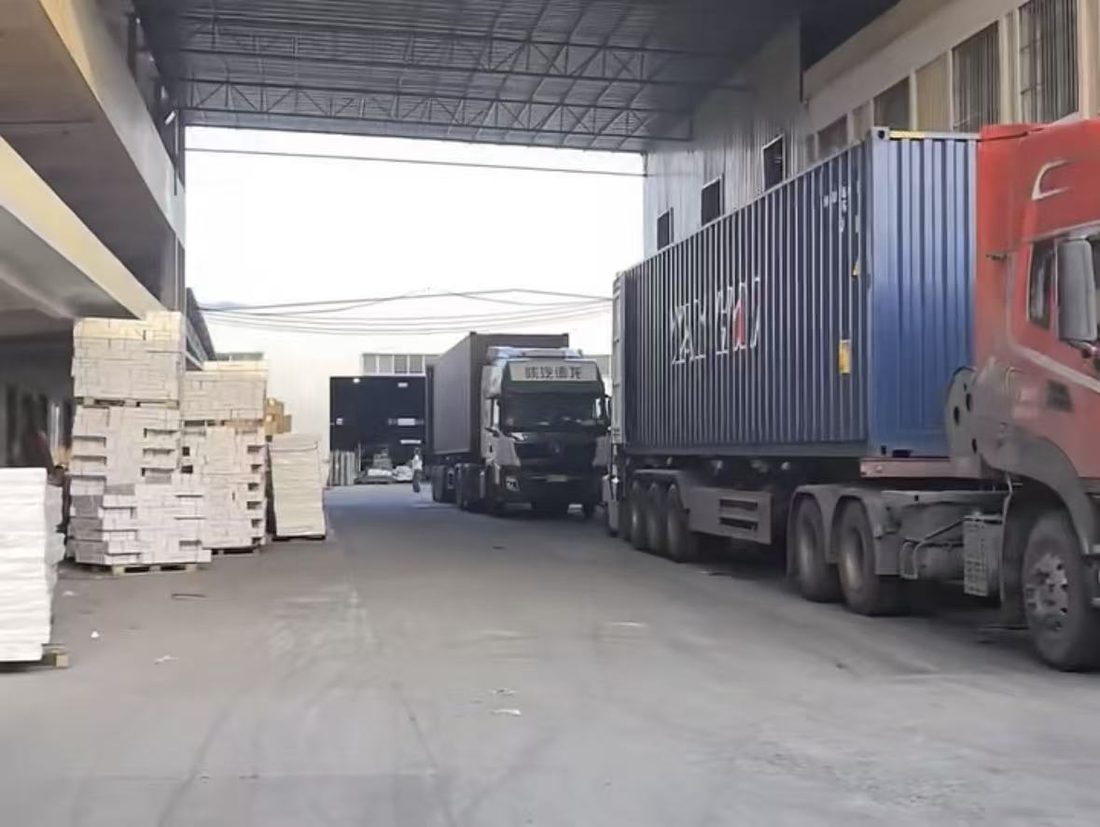
Palletised KD cartons staged beside two 40ft containers at our loading bay in Nanning, Guangxi. A photo like this — plus the packing list and the container number — is what you should ask any supplier for before the container leaves.
Why loading rate matters more than the unit price
Here is the arithmetic that most price negotiations ignore.
Scenario: 40HQ from South China (Shekou / Nansha) to Jakarta, ocean freight USD 900 port-to-port. Port-to-port quotes on this route ranged roughly USD 860–1,200 per 40HQ in 2026 (base ocean freight only — excludes origin charges, destination THC and duty; confirm with your forwarder). Product: 4-door steel locker, FOB USD 32.
| Assembled | KD flat-pack | |
|---|---|---|
| Units per 40HQ | 85 | 565 |
| Ocean freight per unit | USD 10.59 | USD 1.59 |
| Freight as % of FOB | 33.1% | 5.0% |
| Landed cost before duty (goods + freight) | USD 42.59 | USD 33.59 |
Same product, same container, same freight invoice — USD 9.00 per unit difference (about 21% of landed cost). Freight per unit falls by 85%. On a 500-unit order that is USD 4,500, which is usually far more than the discount won by weeks of price haggling.
The line item most comparisons miss. The table above is port-to-port, because that is how freight is quoted. But destination THC, customs clearance and inland delivery to a Jakarta warehouse add a fixed cost per container — say USD 500 on this route (confirm with your forwarder; it varies by port and by who clears). Spread over 85 assembled units that is USD 5.88 each; over 565 KD units it is USD 0.88. Include it and the gap widens from 21% to about 29% of landed cost. Fixed costs always punish the bulky option — which is why the KD case is stronger than the FOB-versus-freight comparison alone suggests.
This is why experienced importers ask two questions together: "What is your FOB price?" and "What is your loading quantity in a 40HQ, and can I see the loading plan?"
How big is a 40ft container? Dimensions, capacity and payload
| 20GP | 40HQ | |
|---|---|---|
| Internal dimensions (typical) | 5.90 × 2.35 × 2.39 m | 12.03 × 2.35 × 2.70 m |
| Theoretical volume | ~33 m³ | ~76 m³ |
| Realistic usable volume | ~28–30 m³ | ~65–68 m³ |
| Max payload (varies by carrier) | ~28,200 kg | ~26,500 kg |
(External dimensions and ratings follow ISO 668; internal measurements vary slightly between container owners — always confirm the booking. A 40ft standard (40GP) is the same length and width as a 40HQ but 30 cm lower: about 67 m³ instead of 76 m³, roughly 12% less cargo.)
How many kg does a 40ft container hold? A 40HQ carries about 26.5 tonnes of cargo (max payload ~26,500 kg after the ~3.9 t tare weight is deducted from the ~30,480 kg gross limit); a 20GP carries about 28.2 tonnes. In practice ocean carriers and destination road limits often cap you at 25–26 t, so confirm the booking. For steel furniture this only matters for heavy-gauge workshop cabinets — most lockers fill the space long before they reach the weight limit.
Two rules of thumb:
- Never calculate at 100% of the theoretical volume. Cartons are not liquid. Corrugations, pallets, door clearance and the need to brace the load typically cost you 10–15%. Plan on 85–90%.
- Volume and weight both matter. Steel furniture is normally volume-limited, but heavy-gauge items can flip to weight-limited. Whichever limit you hit first sets your quantity.
The master loading table: assembled vs KD
Steel lockers
| Model | Volume per unit (assembled) | Volume per unit (KD) | Volume saved |
|---|---|---|---|
| 2-door locker | ~0.75 m³ | ~0.10 m³ | 87% |
| 4-door locker | ~0.75 m³ | ~0.115 m³ | 85% |
| 6-door locker | ~0.75 m³ | ~0.125 m³ | 83% |
| 9-door locker | ~0.65 m³ | ~0.165 m³ | 75% |
Filing cabinets, wardrobes, workshop storage
| Model | Assembled | KD | Volume saved |
|---|---|---|---|
| 3-drawer filing cabinet | ~0.31 m³ | ~0.09 m³ | 71% |
| 4-drawer filing cabinet | ~0.40 m³ | ~0.115 m³ | 71% |
| Steel wardrobe | ~0.83 m³ | ~0.13 m³ | 84% |
| Workshop tool cabinet | ~0.31 m³ | ~0.10 m³ | 68% |
The pattern is consistent: KD packing removes 70–87% of the volume — an assembled locker is mostly air, a flat carton is mostly steel.
Knock-down (KD) lockers vs assembled: why flat-pack wins
What KD means
Knock-down (KD) — also written knock down lockers, flat-pack or CKD — means the unit ships as flat panels plus hardware and is assembled at destination with bolts, rivets or a cam-and-pin system.
The advantages
- 4–8× more lockers per container (about 3.5× for filing cabinets) — the single biggest lever on landed cost.
- Lower warehouse cost at destination — flat cartons stack; assembled units need floor space.
- Less transport damage — flat panels resist impact better than a hollow assembled box that can dent and twist.
- Cheaper inland delivery — smaller cartons, easier local trucking, especially to islands and remote sites.
- Freight flexibility — smaller shipments can still fill a container economically, so you reach MOQ faster.
The trade-offs, honestly
- Assembly labour. A 6-door locker takes roughly 15–25 minutes for one worker with the right tools; add 2–5% to project cost if you hire assemblers.
- Hardware discipline. Missing bolts stop a project. Insist on 2–3% spare hardware per carton and a printed manual per carton, not one manual per container.
- Not everything can be KD. Mobile compactors, welded heavy-duty shelving and some fire-rated cabinets are welded structures — they ship assembled.
- Quality risk if the design is wrong. A well-designed KD joint is stronger than a poorly welded one; a badly designed one rattles. Ask for assembly samples and a joint close-up before committing to volume.
Rule of thumb: KD for anything that fits in a flat carton and gets installed indoors. Assembled only for welded, high-load, or ready-to-use-now requirements.
What changes your loading quantity
Even within the same model, loading quantity moves by 10–25% depending on:
- Steel gauge. 0.5 mm versus 0.8 mm body panels changes weight (payload risk) much more than volume. Heavy-duty steel lockers at 1.0–1.2 mm can hit the payload ceiling before the volume ceiling.
- Shelving. Each extra shelf adds a panel and hardware — roughly 3–5% volume.
- Lock type. Cam locks are flat; electronic or biometric locks add a bulky module and packaging protection.
- Castors or feet. Castors need corner protection and can prevent tight stacking.
- Packaging design. Carton size, foam corners, edge protectors and moisture barrier all consume space. Better packaging costs a little and saves damage claims; the sweet spot is 5–8% volume for export-grade protection.
- Mixed loading. A container of four different models rarely reaches the same rate as a single-SKU container — but mixed loading is often the right commercial choice for distributors.
- Colour and finishing. Powder-coated parts need surface protection between panels; careless stacking scratches and creates rework.
Weight vs volume: the hidden limit
Volume tables can mislead on heavy products. Example: a workshop tool cabinet at ~48 kg and 0.10 m³ packed.
- Volume allows ~650 units in a 40HQ.
- At 48 kg each, that is ~31 tonnes — above the ~26.5 t payload limit.
So the real limit is roughly 550 units (26,500 ÷ 48), set by weight, not space. If your supplier quotes 650 without checking payload, they have not done the loading plan.
The dual-limit check, product by product
Every quantity in the master loading table was tested against both ceilings and set to whichever binds first. For a 40HQ, KD packing:
| Product | Steel weight per unit | Volume cap | Payload cap | Units you actually get |
|---|---|---|---|---|
| 2-door locker | ~28 kg | 620–670 | 946 | 620–670 — volume |
| 4-door locker | ~33 kg | 540–580 | 803 | 540–580 — volume |
| 6-door locker | ~45 kg | 495–530 | 589 | 495–530 — volume |
| 9-door locker | ~62 kg | 375–400 | 427 | 375–400 — volume |
| 3-drawer filing cabinet | ~30 kg | 690–730 | 883 | 690–730 — volume |
| 4-drawer filing cabinet | ~38 kg | 545–580 | 697 | 545–580 — volume |
| Steel wardrobe | ~42 kg | 485–510 | 631 | 485–510 — volume |
| Workshop tool cabinet | ~48 kg | 620–680 | 552 | 540–550 — payload |
The volume column is a range because carton CBM moves ±5% with gauge and shelf count; the payload column is fixed by the weights shown. Those weights are bare steel at nominal gauge — add roughly 4–5 kg per unit for hardware and export packing if your carrier checks against gross weight, which lowers the payload ceiling by about 10% without changing which limit binds, except for the tool cabinet, which is already weight-bound. Whichever number is lower wins — and for the tool cabinet it is the one most suppliers do not quote.
These are typical figures for standard configurations. Because we build to order, carton CBM varies with your size and gauge — confirm the exact loading quantity against the carton dimensions on your quotation before you book freight.
At nominal gauge only one product flips. But the margin is thinner than it looks: a 2-door locker stops being volume-limited at about 39.5 kg per unit. Move from 0.6 mm to 1.0 mm body panels and you cross that line — a 1.0 mm two-door locker lands near 490–520 units in a 40HQ, not 650, with the exact figure depending on hinge and packing weight. The drop looks modest because a two-door carcass is mostly thin panels; hard-gauge steel bites far harder on multi-door units, drawer cabinets and tool cabinets, where the payload ceiling arrives 20–30% below the volume ceiling.
The test is two lines of arithmetic:
- Volume cap = usable m³ ÷ packed CBM per unit
- Payload cap = 26,500 kg ÷ gross weight per unit
Take the smaller number. If you only ever quote the volume cap, you are quoting a container your customer cannot legally load.
This matters most for:
- Heavy-gauge workshop and tool cabinets
- Industrial shelving and racking
- Fire-resistant filing cabinets with insulation
- Products with stone or MDF tops
Ask your supplier to confirm both numbers: CBM per carton and gross weight per carton.
Working through a specific SKU? Send us the model and your target quantity and we will return the carton CBM, gross weight and a 40HQ loading plan within two working days — no quotation required.
How to calculate your own loading quantity
Three steps, no software required:
Step 1 — Get the packed carton volume. Ask for the carton dimensions in millimetres, not the product dimensions.
Carton CBM = L(m) × W(m) × H(m)
Step 2 — Estimate units.
Units = Container usable CBM ÷ Carton CBM
(The usable figure in the table above — 28–30 m³ for a 20GP, 65–68 m³ for a 40HQ — already allows for the 10–15% packing loss, so do not apply the discount a second time. If you start from the theoretical 33 / 76 m³ instead, multiply by 0.85–0.9 first.)
Then check weight:
Units (weight limit) = Container payload ÷ Gross weight per carton
Your real quantity is the lower of the two.
Step 3 — Sanity-check with packing efficiency. If the answer is more than 95% of the theoretical maximum, your supplier is quoting space that the container doors and internal ribs will not give you.
Worked example
4-door locker, KD, carton 1150 × 500 × 200 mm, gross weight 33 kg.
- Carton CBM = 1.15 × 0.5 × 0.2 = 0.115 m³
- 40HQ volume limit = 65 ÷ 0.115 = 565 units (65 m³ is already the usable volume — do not discount it twice)
- 40HQ weight limit = 26,500 ÷ 33 = 803 units
- Binding limit: volume → about 565 units (a supplier quoting 540–570 is realistic; 700 is not)
What a proper loading plan looks like
Before you pay a deposit, request these five items. A professional export manufacturer produces them as routine.
- Packing list with carton dimensions and gross/net weights per SKU.
- Loading diagram or loading sequence — a simple plan view showing rows, layers and remaining space.
- CBM summary — total CBM versus container usable volume, so you can see the efficiency percentage.
- Loading photos — mid-load and full-load, ideally with the container number visible.
- Container number and seal number on the B/L, matching the photos.
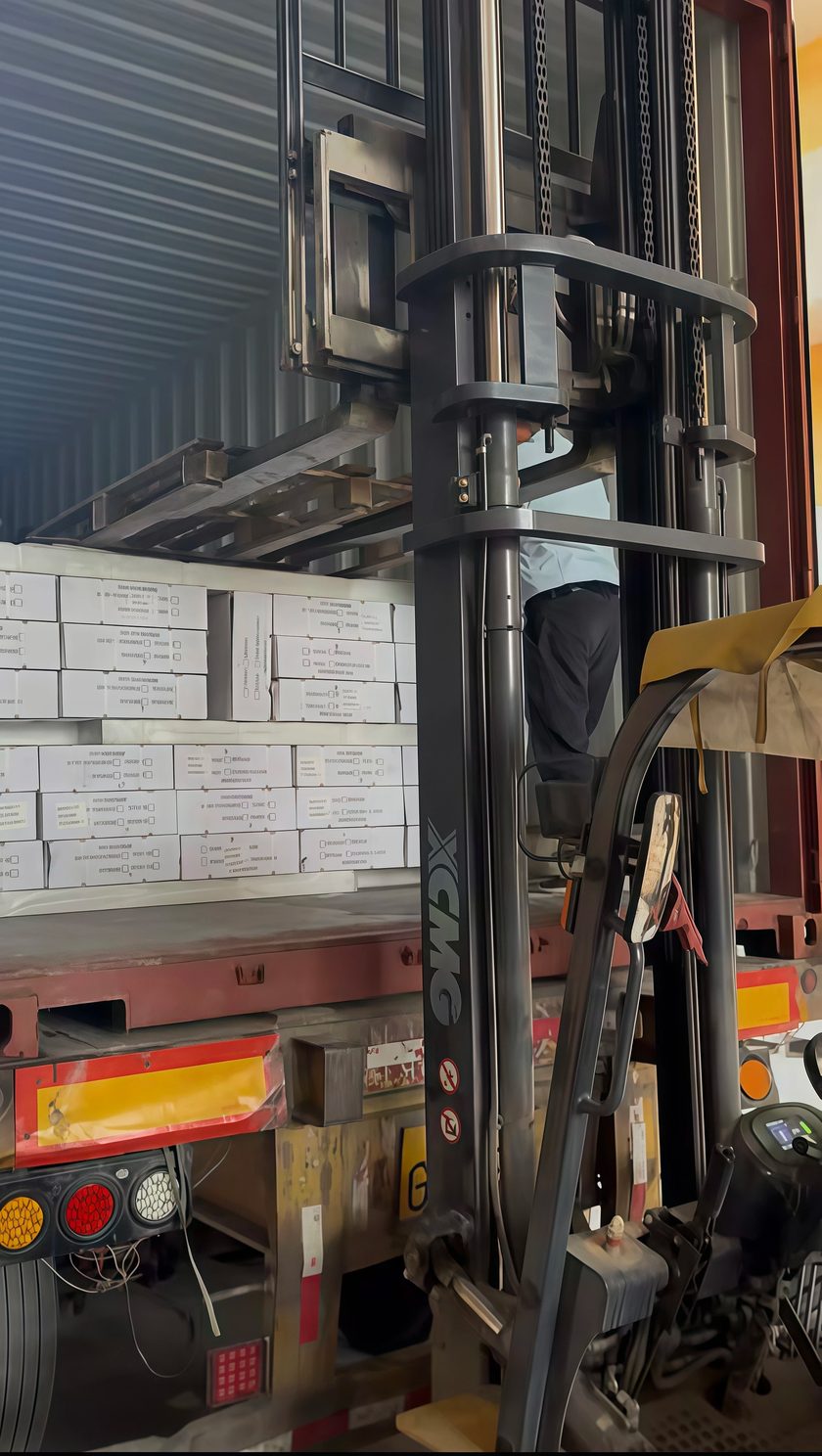
What item 4 is asking for — a pallet going in mid-load. Ask for one frame mid-load and one with the doors closed, plus the container number from the same session.
If a supplier cannot provide numbers 1 and 3, treat their loading claim as marketing.
A packing rate below 80% on a single-SKU container usually means the carton design is inefficient — not that the product is bulky.
FCL, LCL, or mixed containers?
| Option | When it makes sense | Watch out for |
|---|---|---|
| FCL 20GP | 15–30 m³ of goods; first order; island destinations | Per-unit freight is the highest of the three |
| FCL 40HQ | 30–68 m³ (55+ m³ for best utilisation); repeat orders | You need volume to justify it |
| LCL | Under 15 m³; testing a new SKU | Destination charges often exceed the savings; damage risk is higher |
| Mixed container | Distributors buying several categories | Loading rate drops 10–20% versus single SKU |
Breakeven rule of thumb: LCL stops making sense at roughly 12–15 m³. Above that, a 20GP is usually cheaper and safer.
How GXHKM handles loading
Guangxi Huankemei Technology (GXHKM) has manufactured steel furniture since 2011 with a 350-person production team in Guangxi, China — and a logistics choice worth knowing about: Qinzhou (Beibu Gulf Port) is physically closer to Jakarta, Surabaya and Singapore than the northern Chinese ports, which shortens sailing distance. Sailings out of Qinzhou are fewer than out of Shekou or Nansha, though, so we quote both — shorter transit from Qinzhou, more frequent departures from Shenzhen — and let you weigh transit time against rate. Most Southeast Asian buyers pick whichever sailing matches their production date.
What we provide as standard on container orders:
- ✅ KD and assembled options across our locker range, the filing cabinet range, wardrobes and workshop storage systems
- ✅ Packing list with carton CBM and gross weight per SKU, before you confirm the order
- ✅ Loading plan and loading photos for every shipment
- ✅ Export-grade packaging — foam corners, edge protectors, moisture barrier, spare hardware
- ✅ OEM/ODM — size, RAL colour, lock type, logo and carton printing
- ✅ Third-party inspection and testing — SGS or BV pre-shipment inspection, and BIFMA-style load and cycle testing on request (report issued before you book); ISO 9001 quality management system
Frequently Asked Questions
Q1: How many steel lockers fit in a 40ft container? A: For standard 4-door lockers (1800×900×450 mm), roughly 540–580 units KD or 82–88 assembled. Assembled units are mostly air — that is why flat-pack dominates export trade. The range depends on steel gauge, shelving, lock type and carton design. Always confirm with the supplier's packing list.
Q2: What is the standard size of a steel locker? A: 1800 × 900 × 450 mm covers most 2-door, 3-door, 4-door and 6-door lockers. Compact multi-door units (9–15 doors) are usually 1800 × 900 × 390 mm, single-door lockers 1800 × 380 × 450 mm. Custom sizes are available but change the container loading quantity.
Q3: How many kg can a 40ft container hold? A: About 26,500 kg of cargo in a 40HQ (28,200 kg in a 20GP). Carriers and road limits often reduce this to 25–26 t in practice, so confirm with your forwarder before loading heavy-gauge cabinets.
Q4: How many 2-door or 4-door lockers fit in a 40ft container? A: A 40HQ holds roughly 620–670 two-door lockers KD (82–88 assembled), or 540–580 four-door lockers KD (82–88 assembled). The difference comes from carton design and steel thickness, not from container space.
Q5: Is KD cheaper than assembled, including assembly labour? A: Almost always yes. KD typically cuts shipped volume by 70–87%, so freight per unit falls by roughly 85%. Assembly labour of 15–25 minutes per unit rarely costs more than the freight saved, especially on long routes.
Q6: What is a good container loading rate? A: 85–90% of usable volume for single-SKU shipments. Below 80% suggests inefficient carton design or poor loading planning; above 95% claims usually ignore door clearance and bracing.
Q7: Can I mix different products in one container? A: Yes, and for distributors it is often the right call — but expect the loading rate to fall 10–20% compared with a single-SKU container. Ask for a mixed loading plan so you can see the real CBM.
Q8: 20GP or 40HQ — which is cheaper per unit? A: The 40HQ, when you have the volume — but the gap is smaller than most people assume. A 40HQ carries about 2.3× the cargo of a 20GP (76 vs 33 m³), while the freight is usually around 2× (for example USD 900 vs USD 450 port-to-port China–Jakarta in 2026), so the saving is roughly 10–15% per cubic metre. The 40HQ also saves per-unit handling and documentation, and it is the only sensible choice once your cargo passes ~30 m³ — the real win is not the rate difference, it is not having to split the order across two containers or pay LCL rates.
Q9: Will heavy workshop cabinets hit the weight limit? A: Often yes. A 48 kg tool cabinet at 0.10 m³ packed would exceed a 40HQ payload at around 550 units, well below the volume limit. Always check payload as well as cubic metres.
Q10: How many steel lockers fit in a 20ft container? A: A 20GP holds roughly 275–300 two-door lockers KD, 240–260 four-door lockers KD, or 35–40 units assembled. Usable volume is about 29 m³ against 65 m³ for a 40HQ — roughly 45% of the cargo. For a first order under 15 m³, compare LCL rates before defaulting to a 20GP, because destination charges often erase the saving.
Related Articles
- How to Import Steel Furniture from China: The Complete 2026 Guide — documentation, duties and the full import process.
- Steel Lockers in Indonesia: The Complete 2026 Buying Guide — specifications, climate considerations and supplier selection.
- Steel Lockers for Gyms and Fitness Centres in Southeast Asia — a worked specification example for a high-traffic site.
- Steel Locker Buying Guide: 10 Factors to Check Before You Import — steel gauge, coating quality and lock systems in detail.
Conclusion
Container loading is not a detail to settle after the price is agreed — it is one of the largest line items in your landed cost, and it is entirely within your control. Three habits separate importers who protect their margin from those who do not:
- Ask for carton CBM and gross weight before you confirm any order.
- Compare freight per unit, not freight per container.
- Choose KD wherever the product allows it.
Need a loading plan for your next order? Contact GXHKM with your product list and target quantity — we will send a packing list, CBM calculation and loading plan for a 20GP or 40HQ, plus an FOB quotation. - Website: www.hkm-furniture.com - Email: info@gxhkm.com - Phone / WhatsApp: +86 132 6380 9980
About GXHKM
This guide was written by the GXHKM export team. GXHKM Steel Furniture (Guangxi Huankemei Technology Co., Ltd.) has manufactured steel furniture since 2011 at a 60,000 m² factory in Nanning, Guangxi, China, with a monthly capacity of 55,000 units and exports to 98 countries. ISO 9001 certified. More about our factory
Published: 30 October 2026 | Last updated: 1 November 2026
Note: container capacities and freight rates vary by carrier, route and season. Figures in this guide are typical ranges for planning purposes — always confirm against your supplier's packing list and your forwarder's current quote.